Best Camping Kettle UK 2026: 5 Kettles for a Proper Brew Outdoors
There's a moment on every UK campsite — the wind drops, the rain eases, and all you want is a proper brew.
Best Camping Kettle UK 2026: 5 Kettles for a Proper Brew Outdoors
There’s a moment on every UK campsite — the wind drops, the rain eases, and all you want is a proper brew. A good camping kettle turns that ritual from a faff into the highlight of the day. But “camping kettle” covers everything from a budget gas-stove pot to an integrated system that boils water in under two minutes. We researched the current UK market, compared manufacturer specs, and analysed owner reviews across Amazon UK, Go Outdoors and specialist forums to narrow the field to five genuinely different options. Whether you want the fastest boil, the most windproof flame, or a twig-burning classic that costs nothing to run, there’s a kettle here for you.
At a Glance: Quick Picks
| Product | Best for | Approximate price |
|---|---|---|
| Jetboil Flash | Fastest boil on a gas canister | Around £90–£110 |
| MSR WindBurner 1.0L System | Exposed, windy UK campsites | Around £120–£140 |
| Primus Litech Kettle 0.9L | Lightweight pour kettle for an existing stove | Around £25–£35 |
| Kelly Kettle Scout | Free fuel, twig-powered brews | Around £50–£65 |
| Fire-Maple FMS-702 | Best budget camping kettle | Around £20–£30 |
What to Look For in a Camping Kettle
Before you spend anything, it’s worth understanding the different ways a camping kettle can work. Most of the disappointment in owner reviews comes from buying the wrong type, not a bad product.
Integrated Stove Systems vs Standalone Kettles
The biggest decision is whether you want the kettle to come with its own burner. Integrated systems like the Jetboil Flash and MSR WindBurner couple a purpose-built vessel to a stove that clips directly onto the gas canister. Everything nests together, boils fast, and handles wind far better than a loose stove. The catch is cost and single-mindedness — they’re brilliant at boiling water, but most of them pour poorly if you’re trying to do more complex cooking.
Standalone pour kettles like the Primus Litech and Fire-Maple FMS-702 are simply kettles that sit on top of whatever stove you already own. They’re cheaper, lighter, and if you’re already carrying a stove and pot for cooking, they add almost no bulk. The downside: they’re only as fast and windproof as the stove beneath them.
Capacity, Boil Time and Fuel
For one or two people, around 0.8–1 litre is the sweet spot. Larger groups will want something bigger, and twig-burning Kelly Kettles tend to be taller because the fire needs a tall chimney to draw well. Boil times vary wildly: manufacturer specs claim anywhere from 100 seconds for 0.5L (Jetboil Flash) to 4.5 minutes for 1L (MSR WindBurner). Remember those figures are optimum-conditions numbers — cold, windy British weather adds time to almost everything.
Your fuel choice matters too. Gas canisters are the default, but the UK’s colder months push people towards isobutane-propane blends that vaporise better at low temperatures — specifically below 5°C. Two UK-available products stand out here: MSR IsoPro (80% isobutane / 20% propane) and Coleman Performance Blend, both stocked at Go Outdoors and Cotswold Outdoor. Pure butane — the cheap supermarket canisters — performs poorly below approximately 4°C, because the liquid fuel inside stops vaporising and the pressure drops to the point where the flame sputters or dies. Twig kettles sidestep fuel entirely, but they need dry kindling and a site that permits fires — more on that below.
Wind Performance and Stability
This is the specification nobody puts on the box, but it’s arguably the most important in the UK. A naked gas flame in a breeze is spectacularly inefficient, which is why integrated, fully-enclosed burners (the MSR WindBurner especially) get so much love in owner reviews of exposed Scottish and coastal campsites. If you’re on a budget, the practical alternative is a windscreen — but never use one on a canister-top stove without leaving the ventilated gap the manufacturer specifies, or you can overheat the canister to dangerous pressures.
Pour Control and Spout Design
It sounds trivial until you’re scalding your hand in the dark. Pour control is the single most overlooked factor in camping kettle reviews, and it separates the usable from the frustrating.
The Jetboil Flash has no dedicated pour spout — it uses a wide-mouth opening. Amazon UK owner reviews consistently flag boiling water splashing when pouring, which is a real safety concern for anyone brewing in a cramped tent porch or with cold, fumbling hands. Jetboil does sell a separate silicone lid with a pour notch as an accessory, but it’s not included in the box. The MSR WindBurner shares the same pour-control limitation: its wide-mouth cup design makes controlled pouring similarly awkward.
The Primus Litech, by contrast, has a narrow fixed spout that gives a controlled, predictable pour. Owner consensus on forums such as UKHillwalking and BackpackingLight UK rates it significantly safer for single-handed pouring — a detail that matters more than weight when you’re balancing a mug, a stove and a brew kit on a camp mat.
Material, Weight and Packed Size
Aluminium is light and heats fast; stainless steel is tougher and heats slower. Hard-anodised aluminium — as used in the Primus Litech — adds a surface treatment that makes the metal more durable and resistant to scratching, while retaining the fast heat-up of raw aluminium. Weight matters most for backpackers; car campers can afford to carry something heavier if it pours better or holds more water. Packed size determines whether the kettle nests inside your cookset or sits awkwardly alongside it, and the details vary dramatically between models — the Primus Litech, for instance, does not fold flat and needs a cookset with an internal diameter of at least 10cm to nest properly.
Jetboil Flash
Best for: Fastest boil on a gas canister
Approximate price: Around £90–£110
Where to buy: Amazon UK, Go Outdoors
The Jetboil Flash is the kettle most people picture when they think of an integrated camping stove system. It’s designed around a single purpose: boiling water as fast as physically possible on a gas canister, then packing down into a compact unit.
Key specs and what’s included:
- Manufacturer-stated boil time: 100 seconds for 0.5L (under optimal conditions — Jetboil’s own product page figure)
- FluxRing cooking cup with insulating cosy
- Push-button igniter
- Burner base that clips onto a standard threaded gas canister
- Adjustable burner valve
- Drink-through lid with strainer
- Measuring cup / bottom cover that snaps onto the base
The standout strength is raw speed. Under optimal conditions, the Flash brings 500ml of water to a rolling boil in around 100 seconds — fast enough that the kettle can boil before you’re ready, which is in fact the most-cited complaint in Reddit’s r/UKCamping and r/Ultralight_Hiking UK threads. Owners repeatedly mention the Flash boiling water before they’ve got their mug, tea bag or coffee ready, leading to wasted fuel and minor frustration. The system nests entirely within the cooking cup, so the whole unit packs to roughly the size of a large mug.
The honest caveat is pour control. As covered above, the Flash has no dedicated pour spout — it uses a wide-mouth opening, and Amazon UK owner reviews consistently flag boiling water splashing. Jetboil sells a separate silicone lid with a pour notch, but it’s an additional purchase, not a bundled accessory. If you’re planning to pour into a narrow-mouth flask or a small espresso cup, budget for that lid or accept some spillage.
Verdict: The fastest gas-canister boil in this line-up, but you’ll need patience and possibly a separate pour lid to match the speed with control.
MSR WindBurner 1.0L System
Best for: Exposed, windy UK campsites
Approximate price: Around £120–£140
Where to buy: Go Outdoors, Cotswold Outdoor
The MSR WindBurner is the kettle you want when the forecast says “gusts to 40mph” and you’re going anyway. It uses a fully enclosed radiant burner that is essentially immune to wind — the flame isn’t exposed to the air at all, so a howling Scottish headwind doesn’t extend your boil time by minutes.
Key specs and what’s included:
- Manufacturer-stated boil time: 4.5 minutes for 1L
- 1.0L insulated pot with transparent lid
- Radiant burner head with windproof enclosure
- Canister stand (broadens the base for stability on uneven ground)
- Pressure regulator (maintains consistent flame output as the canister empties or in cold conditions)
- Packable design — pot nests over the burner assembly
The standout strength is wind performance. Reddit’s r/UKCamping and r/Ultralight_Hiking UK threads cite the WindBurner more than any other system for exposed coastal and Scottish Highland use, where a conventional stove would be struggling or useless. The pressure regulator is a meaningful addition — it keeps the flame consistent as the canister pressure drops, which matters in cold weather when gas pressure is already reduced.
The honest caveat is twofold. First, the boil time of 4.5 minutes for 1L is significantly slower than the Jetboil Flash’s 100 seconds for 0.5L — though the WindBurner is boiling twice the volume, and in conditions where the Flash would also slow down. Second, the WindBurner shares the same pour-control limitation as the Jetboil: the wide-mouth cup design makes controlled pouring awkward, particularly into narrow openings.
Verdict: The most windproof option here — if you brew in exposed places, nothing else comes close, but accept the slower boil and wide-mouth pour.
Primus Litech Kettle 0.9L
Best for: Lightweight pour kettle for an existing stove
Approximate price: Around £25–£35
Where to buy: Amazon UK, Go Outdoors
The Primus Litech is the kettle for people who already own a stove and just want a well-designed vessel to sit on top of it. It’s a standalone pour kettle — no burner, no integrated system, just a thoughtfully shaped pot with a proper spout.
Key specs and what’s included:
- Confirmed weight: 210g
- Capacity: 0.9L
- Packed height: approximately 14cm
- Material: hard-anodised aluminium (surface-treated for durability while retaining fast heat-up)
- Fixed spout (narrow, for controlled pouring)
- Folding handle (the handle folds; the body does not)
- Lid
The standout strength is pour control. The narrow fixed spout gives a controlled, predictable pour that owner consensus on UKHillwalking and BackpackingLight UK forums rates as significantly safer for single-handed pouring than the wide-mouth designs of the Jetboil or MSR. At 210g, it’s also the lightest kettle in this line-up, and the 0.9L capacity is enough for two decent mugs of tea.
The honest caveat is packed size and nesting. The Primus Litech does not fold flat — the body is rigid, and only the handle folds. At approximately 14cm tall packed, it will not nest inside most compact cooksets without leaving dead air space. Nesting depends on your cookset’s internal diameter being at least 10cm; if your pot is narrower, the Litech sits alongside it rather than inside it, which costs pack space. It’s also worth noting that because it’s a standalone kettle, you need to factor in the weight and cost of your existing stove — the 210g figure is kettle-only.
Verdict: The best pour-control kettle here, and superb value if you already carry a stove — just check your cookset’s internal diameter before buying.
Kelly Kettle Scout
Best for: Free fuel, twig-powered brews
Approximate price: Around £50–£65
Where to buy: Amazon UK, Go Outdoors
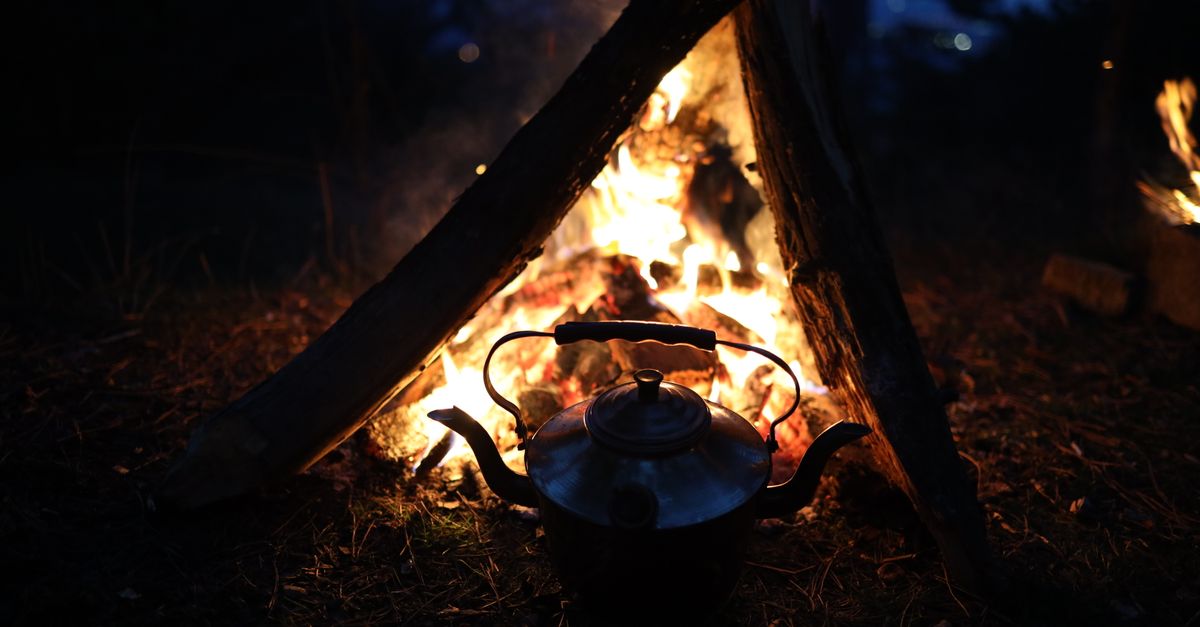
The Kelly Kettle Scout is a design that predates gas canisters by more than a century. You feed twigs, pine cones or dry grass into a small fire base, light it, and the chimney effect draws the heat up through a double-walled water jacket. No gas, no canisters, no fuel cost — just whatever you can forage.
Key specs and what’s included:
- Capacity: 1.2L (not 1.5L — a common misquote)
- Manufacturer-stated boil time: 3–5 minutes, dependent on fuel quality
- Aluminium construction (double-walled water jacket)
- Fire base
- Cork stopper (for carrying water before boiling)
- Drawstring carrying bag
- The chimney/outer jacket functions as the kettle body
The standout strength is fuel independence. Once you own the kettle, your running cost is zero — you burn twigs, cones or dry grass. The 1.2L capacity is the largest in this line-up, making the Scout suitable for small groups. The chimney design is remarkably efficient: the double-walled construction means the fire heats the water from the inside out as well as from the base, which is why a handful of sticks can boil over a litre in 3–5 minutes.
The honest caveat is legal and practical. The Kelly Kettle is classified as an open fire, which means it is banned on most commercial UK campsites regardless of how contained the fire base is. You need a site that explicitly permits open fires, or you need to be wild camping somewhere with appropriate permissions. On Dartmoor — the UK’s most significant wild-camping test case — the position as of 2026 is that wild camping on the commons is permitted following the Court of Appeal’s ruling in Dartmoor National Park Authority v. Darwall [2023], which restored the public right to wild camp under section 10 of the Dartmoor Commons Act 1985. However, open fires remain subject to DNPA fire guidance, and the Kelly Kettle’s open-fire classification means it falls squarely within those restrictions. Current fire restrictions are published at dartmoor.gov.uk/living-and-working/farming/fire. You also need dry kindling — a Kelly Kettle in persistent rain with no dry fuel is a paperweight.
Verdict: The cheapest kettle to run and the most romantic to use — but only if you have a site that permits open fires and dry fuel to hand.
Fire-Maple FMS-702
Best for: Best budget camping kettle
Approximate price: Around £20–£30
Where to buy: Go Outdoors, Amazon UK
The Fire-Maple FMS-702 is the kettle for campers who want a functional, standalone pour kettle without spending integrated-system money. At roughly £20–£30, it’s the most affordable option in this line-up by a significant margin.
Key specs and what’s included:
- Standalone kettle design (sits on your existing stove)
- Hard-anodised aluminium construction
- Fixed pour spout
- Folding handle
- Lid
- Designed to nest with compatible Fire-Maple cooksets
The standout strength is value. For around £20–£30 — roughly a third of the Primus Litech’s price and a quarter of the Jetboil Flash’s — you get a functional hard-anodised aluminium kettle with a proper pour spout. The fixed spout means it shares the Primus Litech’s advantage over the Jetboil and MSR in pour control: you can pour into a mug or flask without splashing. Like the Primus, it’s a standalone kettle, so it pairs with whatever stove you already own.
The honest caveat is that budget shows in the details. The FMS-702 doesn’t match the Primus Litech’s 210g weight or the Jetboil Flash’s 100-second boil time — it’s a conventional kettle on a conventional stove, so performance depends entirely on what you sit it on. It’s also less widely discussed on UK forums than the other four kettles here, so long-term durability data is thinner. As a standalone kettle, it also won’t help you in high wind unless you pair it with a windscreen (used safely, with the ventilated gap the stove manufacturer specifies).
Verdict: The cheapest way to get a proper pour-spout camping kettle — perfectly serviceable, as long as your expectations match the price tag.
UK Practical and Regulatory Notes
Dartmoor Wild Camping and Open Fires
The legal landscape for wild camping in England’s most significant location changed in 2023. In Dartmoor National Park Authority v. Darwall [2023], the Court of Appeal restored the public right to wild camp on Dartmoor commons under section 10 of the Dartmoor Commons Act 1985. As of 2026, wild camping on Dartmoor commons is permitted — but open fires remain subject to DNPA fire guidance, which is published at dartmoor.gov.uk/living-and-working/farming/fire. The Kelly Kettle, classified as an open fire, falls within these restrictions. If you’re planning a Dartmoor brew-up with a Kelly Kettle, check the current fire guidance before you travel.
Open Fires on Commercial Campsites
The Kelly Kettle’s open-fire classification has broader implications: it is banned on most commercial UK campsites regardless of how well-contained the fire base is. Most commercial sites permit gas stoves but prohibit any form of naked flame on the ground. If you’re booked into a standard UK campsite and want to use a Kelly Kettle, you need to confirm with the site directly that open fires are allowed — and many will say no. Gas-powered kettles (the Jetboil, MSR, Primus and Fire-Maple) face no such restriction.
Cold-Weather Fuel Considerations
UK winter camping pushes gas canisters to their limits. Pure butane — the cheap supermarket canisters — performs poorly below approximately 4°C because the liquid fuel stops vaporising and canister pressure drops. Isobutane-propane blends vaporise better below 5°C, making them the practical choice for spring and autumn UK camping. Two specific UK-available products are worth seeking out: MSR IsoPro (80% isobutane / 20% propane) and Coleman Performance Blend, both stocked at Go Outdoors and Cotswold Outdoor. The propane component is the key — it vaporises at much lower temperatures than butane, maintaining canister pressure in the cold.
Frequently Asked Questions
Can I use a Jetboil Flash in strong wind?
The Jetboil Flash has a partially protected burner but is not fully windproof in the way the MSR WindBurner is. In moderate wind it will still function, but boil times will increase and fuel efficiency will drop. For consistently exposed conditions — coastal sites, Scottish Highlands, ridge camps — the WindBurner’s fully enclosed radiant burner is the better choice, as confirmed by owner consensus on Reddit’s r/UKCamping and r/Ultralight_Hiking UK threads.
Why does the Jetboil Flash splash when I pour?
The Jetboil Flash has no dedicated pour spout — it uses a wide-mouth opening designed for drinking directly from the cup. When pouring into a separate mug, the wide opening allows water to exit in an uncontrolled stream, which Amazon UK owner reviews consistently flag as a splashing issue. Jetboil sells a separate silicone lid with a pour notch that addresses this, but it’s an additional purchase rather than a bundled accessory.
Are Kelly Kettles allowed on UK campsites?
Most commercial UK campsites prohibit open fires, and the Kelly Kettle is classified as an open fire because it burns solid fuel (twigs, cones, grass) in an exposed fire base. You need a site that explicitly permits open fires, or you need to be wild camping in a location where fires are allowed. On Dartmoor, wild camping is permitted as of 2026 following the Darwall ruling, but open fires remain subject to DNPA fire guidance published at dartmoor.gov.uk/living-and-working/farming/fire.
What gas should I use for winter camping in the UK?
Use an isobutane-propane blend rather than pure butane. Pure butane — the cheap supermarket canisters — performs poorly below approximately 4°C because it stops vaporising effectively. Isobutane-propane blends vaporise better below 5°C. Two UK-available options are MSR IsoPro (80% isobutane / 20% propane) and Coleman Performance Blend, both stocked at Go Outdoors and Cotswold Outdoor.
Will the Primus Litech kettle fit inside my cookset?
The Primus Litech has a rigid body — it does not fold flat, and only the handle folds. At approximately 14cm tall packed, it will not nest inside most compact cooksets without leaving dead air space. Nesting depends on your cookset having an internal diameter of at least 10cm. If your pot is narrower than that, the Litech will need to sit alongside your cookset rather than inside it.
How much faster is the Jetboil Flash than the MSR WindBurner?
According to manufacturer specs, the Jetboil Flash boils 0.5L in approximately 100 seconds under optimal conditions, while the MSR WindBurner boils 1L in approximately 4.5 minutes. The Flash is boiling half the volume, so a direct comparison isn’t straightforward — but for a single mug of water, the Flash is significantly faster. However, the WindBurner’s pressure regulator and fully enclosed burner mean it maintains performance in wind and cold where the Flash would slow down, so the gap narrows in real-world UK conditions.