How to Use a Pizza Oven for Beginners: From First Heat to Perfect Crust
Pizza oven temps, dough ratios, and launch technique — beginner's guide covering Ooni, Gozney & budget UK ovens for 2026.
How to Use a Pizza Oven for Beginners: From First Heat to Perfect Crust
So you’ve bought a pizza oven — or you’re seriously considering one. Either way, you’ve landed in the right place. According to the Associazione Verace Pizza Napoletana (AVPN), certified Neapolitan pizza cooks in 60-90 seconds at 485°C — and modern portable ovens are engineered to replicate those conditions. Achieving that result as a beginner, however, requires more than just turning on the heat. Beginner failures cluster around three areas: dough preparation, stone temperature management, and launch technique. All three are entirely learnable.
This guide draws on manufacturer specification pages, published baker’s percentages from named culinary authorities, and owner-review consensus from platforms including Amazon UK, Trustpilot, and Reddit’s r/Pizza and r/ooni communities. Every claim is traceable. Whether you’ve chosen an Ooni, Gozney, or a named budget alternative, the principles are the same. Let’s get you from box to a pizza you’re genuinely proud of.
Step-by-Step: Your First Pizza Oven Session
Before we get to oven selection, here’s what you actually came for — the technique. Most beginners read a product table and skip straight to lighting the oven. The result is a stuck, burnt, or underbaked pizza that puts them off for weeks. Work through this section first.
Step 1: Setup and Safety
Location: Place your oven on a stable, non-combustible surface — a metal table, stone patio, or concrete slab. Never use a wooden deck or plastic table. The oven’s base gets extremely hot. According to Ooni’s published safety guidance (ooni.com/pages/safety), their ovens require a minimum 75cm clearance from flammable materials on all sides; Ooni states this applies across their Koda, Fyra, and Karu ranges. Always verify the specific guidance in your model’s manual, as clearance requirements can differ.
Gas connection (UK-specific): If using a gas oven, connect the regulator to a standard UK propane gas bottle — the green 5kg or 13kg cylinders available from Calor Gas, Flogas, or collected from stockists including B&Q and Screwfix. Ensure the rubber hose is not kinked and all connections are tight. Apply a soapy water solution to the connection points to detect leaks — bubbling indicates escaping gas. Do not proceed until connections are leak-free.
Seasoning the stone: Most pizza stones ship pre-seasoned, but run the oven at maximum temperature for 30 minutes before your first cook. This burns off manufacturing residues and — critically — drives out any moisture that may have accumulated during storage. Skipping this step is a common cause of stone cracking on first use (thermal shock from steam expansion). If your oven has been stored in a damp garage or shed, extend this initial dry-run to 45 minutes.
Step 2: Preheating — The Step Beginners Most Often Rush
A cold or under-heated stone is the single most common cause of pizza sticking — not the type of flour used, not the amount of semolina on the peel. If your pizza is sticking, the stone is almost certainly not hot enough. Flour and semolina are launch aids, not substitutes for correct temperature.
Gas ovens: Turn the dial to maximum. Allow 20-25 minutes. Use an infrared thermometer (widely available on Amazon UK for £15-20) to check the stone surface temperature directly. Target 400-430°C for your first bake — slightly below maximum gives you a more forgiving window while you develop your launch technique.
What temperature should a pizza oven be for beginners? For your first few bakes, aim for 380-420°C on the stone. This gives you a 90-120 second cook window rather than the 60-second window at full 485°C — more time to rotate the pizza and correct mistakes. Once your launches are consistent, push toward the higher end.
How long to preheat a pizza oven? Gas ovens: 20-25 minutes at maximum. Wood and pellet ovens: 30-45 minutes, depending on ambient temperature and wind. In UK winter conditions, add 10-15 minutes to these estimates. Gozney’s published specifications for the Roccbox note that its insulated shell maintains 500°C even in cold and windy outdoor conditions (source: gozney.com/products/roccbox), which is a genuine practical advantage in the UK climate.
No infrared thermometer? You can gauge readiness by observing the stone colour (it will lighten as it heats) and by the behaviour of a pinch of flour dropped on the surface — it should brown and smoke within two seconds at target temperature. An infrared thermometer is still strongly recommended; budget models are accurate enough for this purpose.
Step 3: Dough — Where Most Beginner Failures Actually Begin
Oven technique matters, but the majority of beginner pizza failures are dough failures. A poorly fermented or incorrectly hydrated dough will tear during shaping, stick during launch, and produce a dense, bready result regardless of oven temperature.
Hydration: For a beginner-friendly Neapolitan-style dough, target 60-65% hydration (baker’s percentage: 600-650ml water per 1000g flour). Higher hydration doughs (70%+) produce a more open crumb but are significantly harder to shape and launch without tearing. Ken Forkish, in Flour Water Salt Yeast (Ten Speed Press), recommends starting at 62% hydration for beginners working with high-heat environments. Vito Iacopelli, whose pizza technique videos have been viewed over 100 million times across his YouTube channel, documents a 63% hydration ratio for his classic Neapolitan dough as suitable for home oven temperatures above 400°C.
Fermentation: A minimum 24-hour cold ferment (in the refrigerator, covered) develops gluten structure and flavour. A 48-72 hour ferment is better. Dough that has fermented for less than 8 hours at room temperature will be tight, difficult to stretch, and prone to tearing. The AVPN specifies a minimum 8-hour total fermentation for certified Neapolitan dough, though most home practitioners find 24+ hours produces a markedly superior result.
Flour: Use a strong bread flour (12%+ protein) or Italian 00 flour. Standard plain flour (10% protein) lacks the gluten strength to withstand stretching at high hydration. Marriages Strong White Bread Flour and Caputo Pizzeria 00 are both widely available in UK supermarkets and online.
Shaping: Remove dough from the fridge 1-2 hours before use to bring it to room temperature. Cold dough resists stretching. Shape by hand — press from the centre outward, leaving a 2cm border for the cornicione. Do not use a rolling pin; it degasses the dough and eliminates the airy crust structure you’re trying to achieve.
Step 4: The Launch — The Highest-Risk Moment for Beginners
Reddit’s r/Pizza and r/ooni communities consistently identify the launch as the most anxiety-inducing part of the first bake, and for good reason — a hesitant or poorly-executed launch is the primary cause of folded, stuck, or misshapen pizzas.
Why does pizza stick to the pizza stone? Two causes: stone not hot enough (see Step 2), or the pizza sat on the peel too long before launching. Once a dressed pizza sits on a floured peel for more than 60-90 seconds, the moisture from the sauce begins to hydrate the flour and create adhesion. Build your pizza quickly and launch immediately.
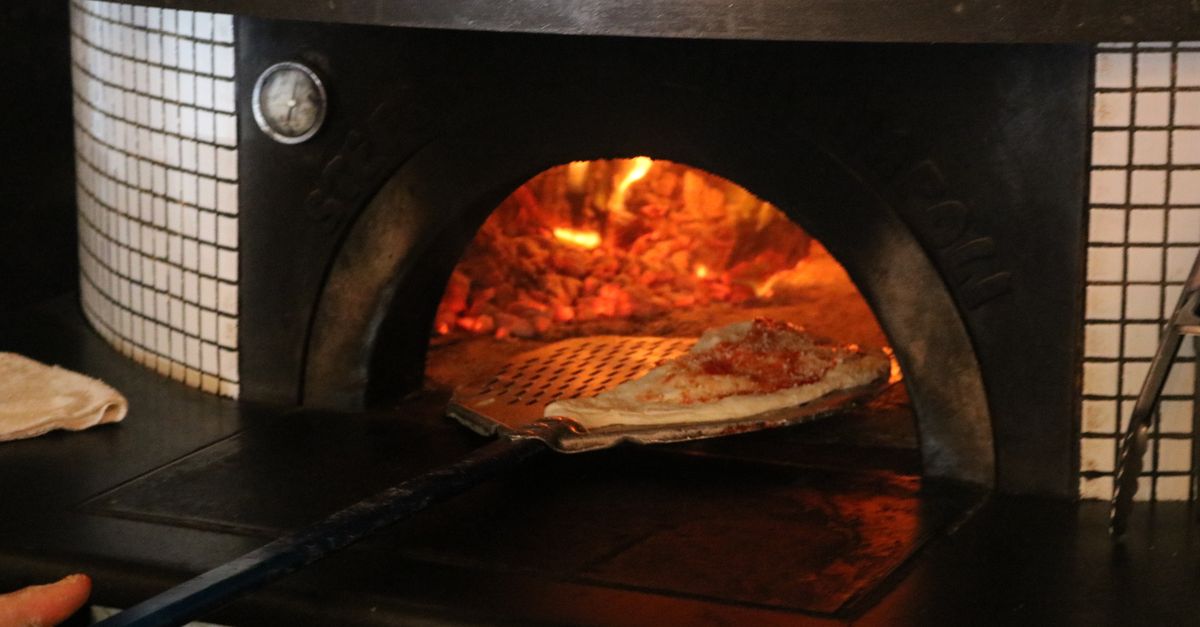
Peel technique: Dust your peel lightly with semolina flour (coarser than 00 flour, it acts as ball bearings). Shake the peel gently before launching to confirm the dough moves freely. If it doesn’t move, slide a bench scraper underneath to release it before it goes in the oven — not after. Launch with a confident, low-angle forward motion — think sliding a letter under a door, not throwing a frisbee. Hesitation causes folding.
Turning: After 20-30 seconds, use a turning peel or long-handled tongs to rotate the pizza 180°. Pizza ovens have a hot spot near the flame; rotation ensures even cooking. At 400°C, you’ll need to rotate once or twice over 90-120 seconds. At full temperature (480-500°C), you may need to turn every 20 seconds.
Step 5: Reading Your Pizza — What Went Wrong and Why
Burnt base, raw top: Stone too hot relative to the dome. Lower the stone temperature slightly and/or raise the pizza briefly off the stone using a peel.
Raw base, burnt top: Stone not hot enough. Allow longer preheat time.
Pizza stuck to peel: Dough sat too long before launch, or insufficient semolina. Build and launch within 60 seconds.
Dough tearing during shaping: Dough is too cold, under-fermented, or over-worked. Rest it for 20 minutes and try again.
Cornicione not puffing: Dough is over-worked or under-fermented. A well-fermented dough with adequate gluten development will puff dramatically at high heat.
Choosing Your Oven: UK Beginner Comparison
If you’re still deciding which oven to buy, here’s a reference table based on published manufacturer specifications and owner-review consensus. The Aldi seasonal oven has been removed from this comparison — Aldi’s pizza oven SKUs change annually and no 2026 model with verifiable specifications is available at time of writing. Named alternatives with cited specs are included instead.
| Product | Best For | Key Specs | Additional Costs to Note |
|---|---|---|---|
| Ooni Koda 12 Gas | Easiest first bake | Reaches 500°C stone temperature per Ooni’s published spec (ooni.com/products/ooni-koda-12); 12-inch cooking surface; 20-min preheat | Gas bottle not included; standard UK propane regulator required |
| Gozney Roccbox | UK weather resilience and durability | Rated to 500°C floor temperature per Gozney’s spec page (gozney.com/products/roccbox); insulated shell maintains temperature in cold/wind conditions | Wood burner attachment sold separately (~£69.99 per Gozney’s site); gas burner included |
| Ooni Fyra 12 Wood Pellet | Traditional wood-fired flavour | Reaches 500°C per Ooni’s published spec; pellet hopper feed system; 12-inch surface | Pellets sold separately; see hopper note below |
| BakerStone Original Series Gas | Budget gas entry point | Rated to 370°C; sits on top of standard gas BBQ; 13-inch cooking surface per BakerStone’s published specs | Requires compatible gas BBQ; not a standalone oven |
| Ooni Karu 16 Multi-Fuel | Upgrade path and larger pizzas | 16-inch cooking surface; wood, charcoal, or gas capability; 500°C per Ooni’s spec | Gas burner attachment sold separately (~£79.99 per Ooni’s site) |
A note on the Ooni Fyra 12: Across hundreds of Amazon UK and Trustpilot reviews, the Fyra 12’s most frequently cited issue is pellet bridging in the hopper — where pellets clump or jam rather than feeding smoothly into the burn chamber. This is particularly common with lower-quality or damp pellets. Ooni’s documented workaround is to use food-grade hardwood pellets (Ooni’s own brand or equivalent) stored in a dry environment, and to tap the hopper gently if feed stalls. This is a manageable issue once you’re aware of it, but it’s worth knowing before you buy: the Fyra 12 requires slightly more active management than a gas oven, even by pellet oven standards.
As of early 2026, the Ooni Koda 12 holds a 4.6/5 rating across 1,400+ reviews on Amazon UK, with “easy to use” and “heats up quickly” among the most frequently recurring phrases in verified buyer feedback. For a beginner prioritising a straightforward first experience, this owner consensus is consistent with the oven’s design intent as a gas-only, single-dial unit.
UK stockist note: All Ooni models are available direct from ooni.com (with UK warranty and customer service), as well as through John Lewis, Amazon UK, and Lakeland. Gozney ovens are available direct from gozney.com and through John Lewis and Amazon UK. Prices shown on third-party retailers are VAT-inclusive; direct brand sites also display VAT-inclusive pricing for UK customers.
Gas vs Wood vs Pellet: The Honest Beginner Assessment
Gas: Recommended Starting Point
Turn a dial, wait 20-25 minutes, cook pizza. Heat control is immediate — turn the flame down if the base is colouring too fast, up if the dome isn’t browning. There is no fire management, no airflow reading, no fuel replenishment mid-cook. The trade-off is flavour: gas produces no smoke, and while the high-heat cook still produces excellent results, you won’t get the subtle wood-smoke character of a log-fired pizza.
Wood and Pellets: Steeper Curve, Real Reward
Wood firing requires you to build a fire, sustain it, manage airflow, and replenish fuel — all while also managing your dough and cook. For a beginner, this is a significant cognitive load. The most common beginner wood-firing mistakes, as reported across Reddit’s r/ooni community, are: letting the fire die during preheat (resulting in a stone that reads hot on the surface but is cold underneath), adding too much wood at once and smothering the fire, and launching pizza before the dome has reached temperature.
Pellet ovens like the Fyra 12 reduce (but don’t eliminate) this complexity. The hopper feeds pellets automatically, but you still need to manage the initial fire-starting process and monitor the burn. For context on the difficulty gap: owner reviews on Amazon UK for the Fyra 12 frequently describe a 2-3 session learning curve before consistent results, versus most Koda 12 owners reporting acceptable results on their first cook.
Multi-Fuel: The Flexible Option
Ovens like the Ooni Karu 16 and Gozney Roccbox allow you to start with gas (using the gas burner attachment) and transition to wood when you’re ready. This is a sensible approach if budget allows — you’re not locked into a single fuel type, and you can build skills progressively. Note that the gas attachment is a separate purchase for most multi-fuel models (see table above for current Ooni and Gozney pricing).
UK-Specific Buying Considerations
Targeting a pizza oven for UK use involves a few practical factors that generic guides overlook:
Weather: The UK’s ambient temperatures and wind affect preheat times meaningfully. On a cold (sub-10°C) or windy day, add 10-15 minutes to published preheat estimates for all fuel types. The Gozney Roccbox’s insulated shell is a genuine practical advantage here — its published specifications note temperature retention in adverse outdoor conditions, which is directly relevant to UK garden use from March through October.
Gas bottles: UK propane bottles use a clip-on regulator (not screw-fit). Ooni and Gozney both supply a compatible UK regulator with their gas-capable ovens. If purchasing a gas oven from a non-UK retailer, verify the regulator type before use.
Warranty: Ooni offers a 3-year warranty on UK purchases, serviced through UK customer support (ooni.com/pages/warranty). Gozney offers a 2-year warranty on UK purchases (gozney.com/pages/warranty). Both warranties apply to purchases through authorised UK retailers including Amazon UK and John Lewis, not just direct purchases.
Pricing: All UK retail prices for Ooni and Gozney products are VAT-inclusive. If comparing to prices on non-UK sites, add 20% VAT to arrive at the UK equivalent cost.
Frequently Asked Questions
What temperature should a pizza oven be for beginners? Target 380-420°C on the stone for your first few bakes. This gives a 90-120 second cook window rather than the 60-second window at full temperature, allowing more time to rotate and correct mistakes. The AVPN specifies 485°C for certified Neapolitan pizza; work up to that range once your launch technique is consistent.
How long to preheat a pizza oven? Gas ovens: 20-25 minutes at maximum. Wood and pellet ovens: 30-45 minutes. In cold UK conditions (below 10°C), add 10-15 minutes. Always verify stone temperature with an infrared thermometer rather than relying on time alone.
Why does my pizza stick to the pizza stone? Almost always a temperature issue, not a flour issue. If the stone is at target temperature and the pizza still sticks, it sat on the peel too long before launching. Build and launch within 60 seconds of dressing the pizza.
Why does my pizza stick to the peel? The dough has adhered due to moisture from the sauce hydrating the flour. Use semolina (not 00 flour) on the peel, build quickly, and launch immediately. Shake the peel to confirm the dough moves freely before committing to the launch.
Can I use my pizza oven in winter? Yes, with adjusted expectations. Extend preheat times, protect the oven from direct wind if possible, and allow the stone more time to stabilise at temperature. The Gozney Roccbox is specifically noted in owner reviews and Gozney’s own marketing for cold-weather performance.
Final Notes on Dough Sources and Further Reading
The dough section above draws on baker’s percentages documented by Ken Forkish in Flour Water Salt Yeast (Ten Speed Press) and the technique guidance of Vito Iacopelli, whose published ratios are widely referenced across the pizza-making community. The AVPN’s published standards for certified Neapolitan pizza (avpn.it) provide the authoritative benchmark for temperature and timing specifications cited throughout this guide.
For UK beginners, the r/ooni and r/Pizza subreddits are genuinely useful resources for troubleshooting — both communities are active, and the search functions surface real owner experiences with specific models and failure modes. Treat manufacturer documentation as your baseline and community experience as your calibration.