Isle of Arran Wild Camping Map: Granite Ridges an Hour from Glasgow
Wild camping on Arran under Scotland's access right — Glen Rosa, Glen Sannox, the granite ridges, Hutton's Unconformity and getting there by ferry.
Isle of Arran Wild Camping Map: Granite Ridges an Hour from Glasgow
Arran is the easiest serious wild camping in Scotland to reach. An hour on the train from Glasgow, an hour on the ferry, and you are walking into a glen beneath granite ridges that would not look out of place in the north-west Highlands. The island is called “Scotland in miniature” because the Highland Boundary Fault runs straight through it, putting rugged Highland mountains in the north and gentler Lowland farmland in the south. This guide is based on desk research: the Scottish Outdoor Access Code, NatureScot and National Trust for Scotland guidance, ferry operator information and Ordnance Survey mapping rather than first-hand testing. Below you will find the legal position, the best glens to camp in, and the ridges that make Arran worth the crossing.
Quick Reference
| Area | Character | Notes |
|---|---|---|
| Glen Rosa | Classic U-shaped glen under Cir Mhòr | The best introduction; basic campsite plus wild ground beyond |
| Glen Sannox | Steeper, wilder, north-facing | Dramatic and quieter than Rosa |
| The Saddle | Pass linking Rosa and Sannox | High, exposed, superb |
| South Arran | Farmland, forestry and coast | Gentler; not the reason to come |
The Legal Position
The Land Reform (Scotland) Act 2003 created a statutory right of responsible access to most land and inland water in Scotland, and that right explicitly includes wild camping. Arran is in Scotland and the right applies here in full. There are no camping byelaws on Arran — the permit scheme applies only to seasonal management zones in Loch Lomond and The Trossachs National Park.
Responsible camping under the Scottish Outdoor Access Code means lightweight, small-scale and short-duration: a small tent, one or two nights, carried in on foot, well away from buildings and roads. The right does not cover campervans or sleeping in a vehicle, which are matters of ordinary parking law — worth knowing on an island where parking is limited and the ferry meters how many vehicles arrive.
The northern mountains, including Goat Fell, are owned by the National Trust for Scotland. That does not remove the access right, but the ground around Brodick Castle and the country park is managed more actively than open hill, and signage there should be followed.
Getting There
The main crossing is CalMac from Ardrossan to Brodick, roughly 55 minutes, with Ardrossan Harbour on the train line from Glasgow Central. In summer a second service runs from Claonaig on the Kintyre peninsula to Lochranza in the north, which is useful if you are touring.
Foot passengers rarely have difficulty; vehicle spaces book out well ahead in summer and during holidays. Since the good camping is all walk-in from Brodick or Sannox, going as a foot passenger and using the island bus service works well and removes the ferry’s main constraint.
Where to Camp
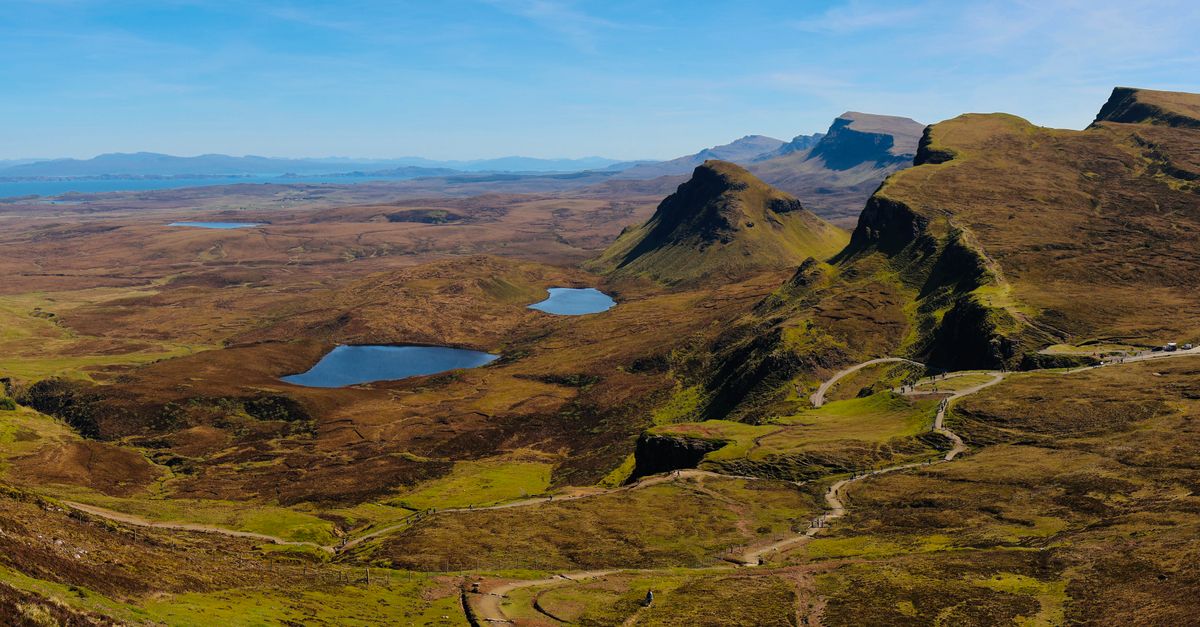
Glen Rosa. The classic Arran walk-in and the obvious first choice. The track runs up from Glen Rosa Water near Brodick into a textbook glacial U-shaped valley, with Cir Mhòr rising at its head like a granite spearhead. There is a basic National Trust for Scotland campsite in the lower glen with minimal facilities and a small charge; beyond it, the upper glen gives genuine wild camping on flat ground beside the burn. Roughly two to three miles of easy walking gets you somewhere that feels a long way from the ferry terminal.
Glen Sannox. The northern counterpart, reached from Sannox on the east coast. Steeper, narrower, north-facing and noticeably wilder than Rosa, with old barytes mine workings low down and a fine head-of-glen setting beneath Cìr Mhòr and Caisteal Abhail. It sees fewer people than Rosa.
The Saddle. The col linking Glen Rosa and Glen Sannox, directly beneath Cir Mhòr. Camping up here is exposed and magnificent, with both glens falling away on either side. Water is available on the descents rather than at the col itself, so carry it up.
Glen Iorsa and the western glens. Longer, wetter, boggier and much less visited. If solitude is the point, this is where to go, but the ground is harder work and the walking rougher.
Lochranza and the north coast. Low-level and accessible, with the ruined castle and red deer that habitually wander through the village. Pleasant, though close to the road and busier.
The Ridges
Arran’s northern hills are granite, and they behave differently from the sandstone and quartzite of the north-west. The rock is rough, grippy and weathers into slabs, tors and blocky crests.
Goat Fell at around 874m is the island’s high point and the standard objective, usually climbed from Brodick or Corrie. The summit view across the Firth of Clyde is exceptional on a clear day.
Cir Mhòr at around 799m is the finer hill by a distance — a steep granite peak standing at the junction of Glen Rosa, Glen Sannox and the Saddle, with excellent rock climbing on its faces.
The A’Chir ridge is the serious one. It is a genuine scramble with exposed sections and a notorious “bad step”, and it should be treated as a rock route rather than a hillwalk. In the wet, granite slabs become slick and the ridge is best avoided by inexperienced parties.
Caisteal Abhail and the Witch’s Step (Ceum na Caillich) continue the ridge line north, with more scrambling.
Geology Worth a Detour
At Newton Point near Lochranza is Hutton’s Unconformity, where James Hutton identified in 1787 the junction between two rock sequences of vastly different ages and orientation. It was central evidence for the idea that the Earth was immeasurably older than then assumed — one of the foundational observations of modern geology, on a beach you can walk to.
The Highland Boundary Fault crosses the island roughly between Brodick and Machrie, and the change in landscape either side of it is unusually legible.
Machrie Moor on the west coast holds a remarkable concentration of Bronze Age standing stone circles, reached by a short walk from the road.
Practical Notes
Adders. Arran has a healthy adder population, and they are most often seen basking on paths and warm rocks in spring and early summer. They are shy and bites are rare, but watch where you put hands and feet in bracken, and keep dogs close.
Midges run from late May to September, worst in still, damp conditions at dawn and dusk and worst in the sheltered lower glens. Higher, breezier pitches are much better. Ticks are abundant in the bracken that covers much of the lower hillsides.
Ground is wet. Glen Rosa and Glen Sannox both have boggy sections and the western glens are worse. Waterproof footwear earns its keep.
Water from running burns above habitation is the pragmatic choice; filter or treat lower down where deer and sheep concentrate.
Facilities are good by wild-camping standards — Brodick has shops, food and transport, and there is a bus service round the island. This makes Arran unusually forgiving for a first multi-day trip.
Deer stalking takes place on parts of the island in season, roughly July to late October for stags. The NTS ground is generally unaffected, but on other estates it is courteous to check.
Responsibilities
- Toilet waste buried at least 30m from water, or carried out. Glen Rosa’s popularity makes this a real issue in summer.
- No open fires. Arran’s glens have seen fire scars and felled saplings; use a stove.
- One or two nights, then move on.
- Everything out, food waste included.
- Small groups, well away from the campsite and the farm ground.
Arran’s accessibility is its strength and its vulnerability. Glen Rosa in particular absorbs a lot of first-time wild campers, and the difference between it staying open and informal or being managed like Loch Lomond is entirely down to how those visitors behave.
FAQ
Is wild camping allowed on the Isle of Arran? Yes. Arran is in Scotland, so the Land Reform (Scotland) Act 2003 applies and responsible wild camping is a statutory right under the Scottish Outdoor Access Code. There are no camping byelaws on Arran — the permit system applies only to seasonal zones in Loch Lomond and The Trossachs National Park.
Where is the best wild camping on Arran? Upper Glen Rosa is the classic, two to three miles of easy walking from Brodick into a glacial glen beneath Cir Mhòr. Glen Sannox is wilder and quieter, and the Saddle between the two is a superb if exposed high camp. There is also a basic National Trust for Scotland campsite in lower Glen Rosa if you would rather have facilities.
How do I get to Arran without a car? Take the train from Glasgow Central to Ardrossan Harbour and the CalMac ferry to Brodick, around 55 minutes. Foot passengers rarely need to book far ahead, unlike vehicles, and an island bus service connects Brodick, Sannox and Lochranza. Since all the good camping is walk-in, going without a car is genuinely the easier option.
Are there adders on Arran? Yes, Arran has a healthy adder population and they are commonly seen basking on paths and rocks in spring and early summer. They avoid people and bites are rare, but take care where you place hands and feet in bracken and long grass, and keep dogs under close control.